Part 11
Will Democrats finally pass their data center guardrails?
By Christopher Stern, Contributing Writer
January 7, 2026
When the General Assembly meets Jan. 14, Democrats will face one of their greatest challenges of the Internet era: making good on their sweeping promises to protect Virginians from the unbridled growth of data centers.
Last year’s assembly failed to enact dozens of proposed bills targeting the energy-intensive data centers. Only one made it to Gov. Glenn Youngkin’s desk and he vetoed it. That bill would have required data center developers to examine the impact of new construction on water, agriculture and nearby residences.
After November’s election, Democrats have a sizable majority in the House, continue to control the Senate and will soon occupy the executive mansion once Gov.-elect Abigail Spanberger is sworn into office Jan. 17.
“Democrats made promises,” said Sen. Russet Perry, a Democrat who represents parts of both Fauquier and Loudoun counties. “Gov. Spanberger made promises about specifically protecting ratepayers. And so I think that there is an onus on us to make sure data centers pay their fair share and that Democrats do deliver on the things that they said they were going to do.”
Perry is a member of a loose coalition of more than a dozen legislators pushing for more data center regulation. The group includes lawmakers from throughout Virginia, but lawmakers from Northern Virginia are overrepresented, which isn’t surprising given that the region has the highest concentration of data centers in the world.
Coalition members support a variety of reforms ranging from protecting ratepayers from higher electric bills to complete moratoriums on new data centers. Not every lawmaker supports every proposal and not every proposal will become law, but there is broad bipartisan consensus that the industry needs more oversight.
“I always say we're not trying to reform anything. We’re trying to actually regulate an industry that’s relatively unregulated,” said Perry.
Perry plans to reintroduce a bill that aims to protect ratepayers from subsidizing data center growth. It’s a critical issue in Virginia, where that growth has led to billions of dollars in investment on energy infrastructure, including transmission lines and substations. Dominion Energy plans to invest more than $50 billion between 2024 and 2029, much attributed to data center development. Under current rate plans, Virginians pay more than half of infrastructure costs, according to a report published by the Joint Legislative Audit and Review Commission, which serves as the General Assembly’s research arm.
The State Corporation Commission recently approved a request from Dominion Energy to create a special customer class for data centers. That decision will allow Dominion to allocate more infrastructure costs to data center owners. The SCC’s ruling covers only Dominion, one of more than 30 power companies in Virginia.
Dominion spokesman Aaron Ruby said the SCC decision protects consumers. “We’ve put in place important protections to make sure data centers pay for the full cost of their power and to prevent their costs from being passed on to residential customers,” said Ruby. When it comes to legislative proposals to further address rate issues, Ruby said it was too early to comment.
The SCC’s decision is a “huge first step” toward protecting ratepayers, but not enough, said Chris Miller, president of the nonprofit Piedmont Environmental Council. He estimates that over 30 years, the SCC’s decision will cover only 60 percent of data center-related capital costs. Miller’s group is one of more than 10 environment and social justice groups pushing for increased regulation of the data center industry. Those groups also include Clean Virginia, Virginia Poverty Law Center, Appalachian Voices and the Southern Environmental Law Center.
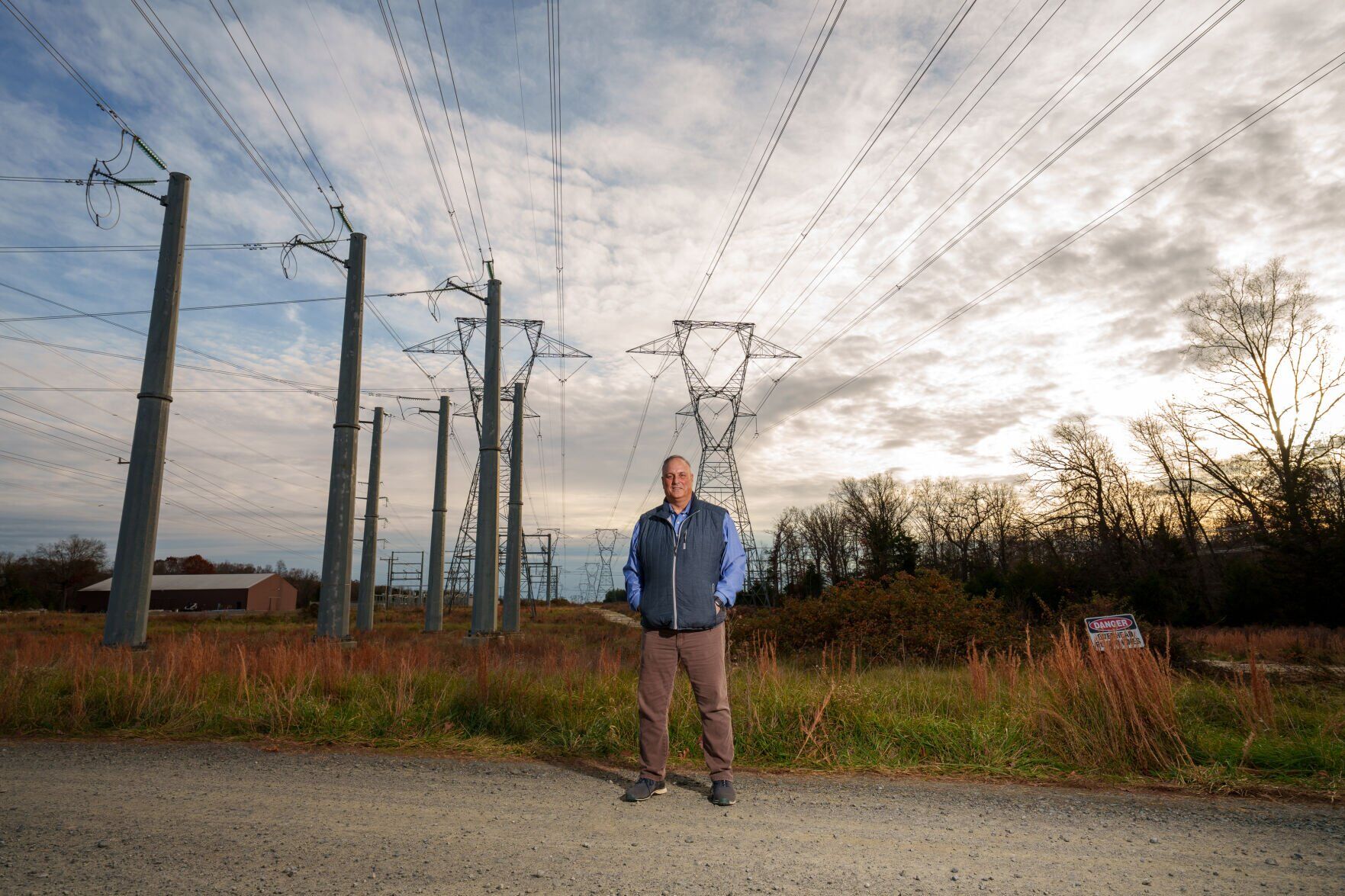
Chris Miller, president of the Piedmont Environmental Council, says the new SCC customer-class ruling protects only about 60 percent of Virginia’s ratepayers. Photo by Doug Stroud.
Dominion is watched closely because it has strong influence in the state legislature. It has been the largest donor to political campaigns for more than a decade, a period when it gave more than $40 million to political candidates in Virginia. It has given much of that money in the last two years as data centers became a hot political issue. In the last two years it gave more than $17 million to both Democrats and Republicans, according to the Virginia Public Access Project.
At a time when inflation remains a sore spot for consumers, lawmakers are not likely to give up on the rate issue. “Affordability” has become a key talking point for Democrats across the country. Not only did Spanberger highlight it as a key campaign issue, but newly elected Del. John McAuliff, a Democrat who will represent parts of Fauquier and Loudoun counties beginning this month, made it a key part of his campaign.
“There's no reason Virginians should be paying for the infrastructure being used by the world's biggest, wealthiest companies,” McAuliff said. The top five tech companies – Nvidia, Apple, Alphabet, Microsoft and Amazon – have a collective market cap of more than $18 trillion.
The Data Center Coalition, a trade group that represents data center developers and tech companies, points out that the industry is a source of tax revenue and jobs. The industry annually contributes more than $9 billion to Virginia’s economy, according to JLARC.
The DCC expects to play an active role in defending against efforts to bring more oversight to data center construction, taxation and rate regulation. “We look forward to continued collaboration with state leaders to help ensure a reliable, affordable electrical grid for all users in the Commonwealth,” said Nicole Riley, director of Virginia government affairs for the Data Center Coalition, in an emailed statement.
Data center growth has led to a dramatic hike in demand for electricity across Virginia. That means higher bills for residential consumers. While a data center can be built in less than a year, it can take up to a decade to approve and build new power plants. Monthly bills are increasing partly because regular customers are competing with some of the largest companies in the world for access to electricity.
McAuliff isn’t stopping at rate regulation. He would like to see tax money that data centers generate finance state parks and pay for conservation easements to curtail land development. “I want to make sure we keep them off the prime agricultural land,” he said.


Del. Michael Webert wants farmland protected and counties to share data center tax revenues; Del. Michelle Maldonado wants residents sheltered from data center infrastructure costs. Submitted Photos.
Protecting farmland is a goal shared by fellow Del. Michael Webert, a Republican and fourth-generation farmer who represents rural areas in Fauquier, Culpeper and Rappahannock counties. One of his biggest concerns is construction of new transmission lines over rural areas. “Farmland lost is farmland lost forever,” said Webert, who also opposes utility-scale solar fields.
Such fields occupy on average seven acres, according to a study last year funded by the state Department of Energy. Hundreds of them are in development in Virginia.
Webert regularly works with Democrats on data center-related issues. Asked why more data center legislation didn’t pass in 2025, Webert noted, “I don’t know. My party wasn’t in charge.”
He believes that Prince William and Loudoun counties, host to the highest concentration of data centers in the state, should be forced to share their tax revenue from the data centers. He introduced a similar bill in 2024 but it failed to advance.
“There's a large amount of tax revenue that's going to come into Prince William because of their approval of these massive data center campuses, but that power line is going to come through Fauquier County,” said Webert. “It is my belief that that is not a fair thing to happen, and that Fauquier County should at least get some revenue out of it.”
He is working with Del. Michelle Maldonado, a Democrat who represents parts of Prince William County. Maldonado notes that the Democrats’ priority is ensuring that ratepayers are financially protected from data centers. But she also notes her collaboration with Webert shows that the issue is broadly bipartisan.
Sen. Danica Roem, also a Democrat representing Prince William County, is pushing for greater regulatory control over data centers. Among her biggest concerns is that data center construction is approved at the county level with little input from state regulatory authorities.
“You cannot under any circumstances make the argument that data center siting is a local land-use issue,” she said. Roem points out that data centers demand an enormous amount of electricity and water, which has regional and even statewide impacts.
One step toward more state review of data center energy use is a bill already introduced by Roem that would require Virginia’s Department of Energy and the SCC to review utility company plans to ensure consumers have reliable energy. Roem’s bill comes as utilities are predicting a data center-related squeeze on energy supplies that will result in more frequent blackouts and brownouts.
Roem would also like to end incentives aimed at attracting more data centers to Virginia. Those incentives add up to $900 million annually even as the state is struggling to manage the unbridled data center demand. It was one of several recommendations included in the JLARC report on data centers issued in late 2024.
Even though the report came out just weeks before the 2025 legislative session took place, Del. Josh Thomas, a Democrat representing Prince William County, put forward a bill that included many of its recommendations. Youngkin, a vocal proponent of data center growth, vetoed the legislation despite strong bipartisan support.
Thomas plans to reintroduce his bill, which would require site assessments before any zoning changes could be approved for a data center. Those assessments would review impacts on water, agriculture, parks and historic sites.
Thomas wouldn’t discuss conversations he has had with Spanberger or her office, but did say he was confident that his bill will become law in the upcoming session. “I will just say that I am very optimistic that it will pass the governor's office,” said Thomas.