Part 10
Is Virginia’s Clean Economy Act dead?
By Peter Cary, Contributing Writer
January 5, 2026
When it was passed in 2020, the Virginia Clean Economy Act was heralded as the first law of its kind in the South. It talked of closing coal-fired plants and laid out a schedule for Dominion Energy and Appalachian Power to produce completely carbon-free electricity by 2045 and 2050 respectively.
“At the end of the day, Virginia ended up with one of the most comprehensive and clear pathways to 100% clean electricity of any state in the country,” said Mike Town, executive director of the League of Conservation Voters in Virginia, who helped draft the bill.
But five years after passage, its clean-up has stalled. The data-center and AI explosion is forcing utilities to take desperate measures to generate more energy, even using dirty fuels. And, it turns out, the law provided exemptions allowing them to do so.
Now, Dominion Energy says it does not see how it can transition to clean energy by 2045.
Defenders of the act note that it was drawn up before the data center explosion was even imaginable, when year-to-year power demand was stable and a transition to clean power in 25 years seemed feasible.
They also say the act set the tone for a cleaner Virginia by pushing a host of clean-energy initiatives. It declared that wind, solar and battery and other storage-based power is a public necessity. It relaxed power bill payments for low-income residents. It steered green energy certificate-buying to Virginia projects.


Mike Town, director of the League of Conservation Voters in Virginia, and state Del. Rip Sullivan helped draft and push through the VCEA, making Virginia “a leader in clean energy.
“The VCEA has been a historic success,” said state Del. Rip Sullivan, (D-Fairfax) who sponsored the legislation. “It vaulted Virginia from the back of the pack to the front, making Virginia a leader in clean energy, bringing investment and jobs to Virginia as well.”
He pointed to data collected at the University of Virginia that shows that in the five years since the act was passed, 230 solar projects with 9,309 megawatts of power have been permitted. Dominion’s offshore wind project with 2,600 megawatts of power is expected to come online next year.
Some say the act also works to counter data center growth, as it slows the building of fossil-fuel plants to power them. The act “is the single thing that tempers unfettered fossil fuel growth for power generation in Virginia,” said state Sen. Danica Roem, a Democrat from Prince William County who voted for the bill.
But a close look at the act and its results reveals serious loopholes that affect its biggest promise. One is an “enactment clause” that says the act will not require the SCC or a utility to take any action that “threatens the reliability or security of electric service to the utility's customers.”
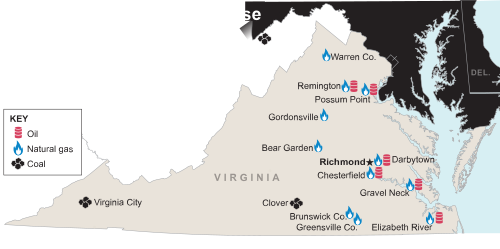
At the end of November, the State Corporation Commission, which regulates Virginia’s utilities, approved Dominion’s proposed 600-megawatt gas-powered peaking plant at Chesterfield, Va., scheduled to be finished by 2029. Dominion plans to seek permission to build seven more gas plants from 2032 to 2038 to serve data center power demand that is expected to nearly triple in five years. Natural gas is a fossil fuel, though it emits about half the carbon dioxide coal does.
“We conclude there is a threat to reliability sufficient to warrant the approval of a fossil-fueled generation resource,“ the commission said in its Nov. 25 order.
Critics worry that the “reliability” clause can be used too freely. “That ruling sets a major precedent for utilities to say, okay, because giant tech corporations have chosen Virginia, we can essentially ignore clean-energy generation requirements,” said Kendl Kobbervig, communications director for Clean Virginia, a staunch critic of Dominion Energy.
Sullivan said in an email that the law he sponsored requires all coal plants to be closed by 2045 and that “Dominion cannot build gas plants unilaterally.” In the case of the Chesterfield plant, he said, “the SCC made clear that its action in that particular case did not signal any intention to approve any future gas-plant requests by Dominion.”
But Dominion, a political powerhouse in Richmond, sees things differently.
“The reliability provisions of the Virginia Clean Economy Act allow coal and natural gas plants to be built and remain online after 2045 if the SCC determines it’s necessary to maintain reliable electric service for our customers,” wrote Dominion spokesman Tim Eberly in an email.
He added that Dominion estimates it would cost customers $175 million to retire all coal and gas plants because they would have to be replaced by new nuclear plants, small nuclear reactors, and much more solar and battery storage. “That is not a realistic or affordable option for our customers,” he said.
Between 2015 and 2023, Dominion retired 16 coal-burning units at six power plants. A company spokesman said the reasons varied: age, efficiency, emissions and economics. Two were retired at Chesterfield in 2019, and two in 2023 to prepare for the new gas-burning plant.
That leaves the company with three coal-fueled plants, which produce roughly 10 percent of Dominion’s power. Clover Power Station, producing 848 megawatts in the state’s southern tier; the 600-megawatt Virginia City Hybrid Energy Center in Wise County, which runs on coal, coal scraps and bio-fuels; and the 1,600-megawatt Mount Storm Power Station near Bismark, West Virginia.
Clover and Virginia City are specifically exempted in the law; the exemptions were written into the bill to win the votes of local legislators, those familiar with its drafting say. And Mount Storm, not being in Virginia, is not covered by the act.
Clover emitted more than 1 million tons of CO2 in 2024, according to the Global Energy Monitor. The Virginia City plant emitted 1.3 million tons in 2024, equal to the CO2 output of 260,000 cars. (The dirtiest power plant in the U.S., the James H. Miller plant in Alabama, emitted 17.2 tons of CO2 in 2023.)
“You’re correct that Virginia City, Clover and Mount Storm are still operating, and we have no plans to retire them,” wrote Dominion spokesman Aaron Ruby.
Dominion is also in partnership with other utilities to build 500- and 765-kilovolt lines to tap coal-fired plants in West Virginia. Two of those plants, Harrison Power Station in Harrison County and Fort Martin Power Station near Morgantown, were headed toward retirement between 2035 and 2040, but now have a new life.
“It’s clear that we must extend the useful lives of these existing coal fleets in West Virginia,” said West Virginia Gov. Patrick Morrisey in September. “We have to do it because the power demands that our country faces are so severe.”
The 1,984-megawatt Harrison Power Station released more than 12 million tons of greenhouse gases in 2023, making it the 12th dirtiest in the country, according to the U.S. Environmental Protection Agency. Fort Martin, which generates 1,152 megawatts of power, emitted 3.9 million tons of CO2 in 2024.
Besides coal-fired power, Dominion has 11 generators in Virginia that run on diesel fuel or natural gas. The company had listed five for potential retirements, but its latest Integrated Resource Plan lists no retirements, and Dominion would like one-third of its power to come from gas in 2045.
Indeed, with 40 more gigawatts of demand predicted by 2045 for the Dominion zone – the Virginia area where the company runs its power lines – Dominion has plans to build enough solar to produce 17,500 megawatts of power; six small-modular nuclear reactors to supply 1,944 megawatts starting in 2040; the seven gas-fired plants, producing a total of 8,510 megawatts; and 2,600 megawatts of offshore wind in 2026, doubling to 5,200 megawatts by 2045.
The wind part of the portfolio received a shock on Dec. 22 when the Trump administration put the construction of all East Coast offshore wind projects on hold over concern that they might cause interference in coastal surveillance radar.
“Virginia’s grid needs addition of electrons, not subtraction,” Dominion said in an angry statement. On Dec. 23 the company challenged the shutdown in federal court, saying it was causing Dominion to lose $5 million a day.
A graphic of Dominion's “preferred plan” for power generation by 2045 shows 54% wind, storage and solar; 8% nuclear; and 33% combined gas and steam generators. A “least cost” version adds 4% coal.
“The Company does not currently see a viable path towards full retirement of all carbon-emitting resources by 2045,” Dominion said in a November report.
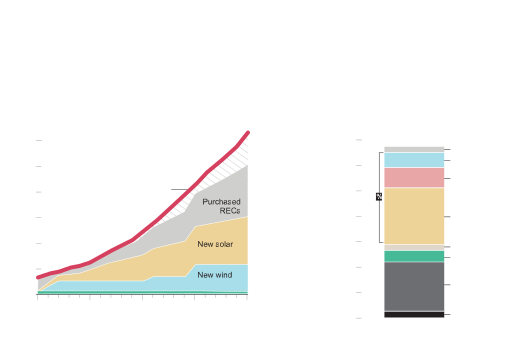
With coal plants not closing, and with more gas-fueled turbine generators in the works, the VCEA is left with one lever to move the state’s two main utilities toward cleaner energy production: the Renewable Portfolio Standard, or RPS. This is depicted in the VCEA as sliding scales, slightly different for Dominion and Appalachian Power. In Dominion’s case, the scale requires it to generate a percentage of its power as clean energy, with the requirement moving from 29% in 2026 to 100% in 2045.
If the company does not have enough clean energy in its generation portfolio, it can make up the difference by buying renewable energy certificates, or RECS, from solar- or wind-power producers in Virginia.
The RECs certify that a clean power generator contributed to the grid. They amount to an investment in clean energy, but are controversial because the companies that buy them may claim they are powered by clean energy when technically they are not – an example of a practice known as “greenwashing.”
“If they don't have the green power on their own grid, they have to pay for renewable energy certificates, and that's what they'll do. I mean, they'll keep these plants running,” said Steve Haner, a senior fellow at the Thomas Jefferson Institute for Public Policy, who has written extensively about the VCEA.
Dominion has petitioned the SCC to charge ratepayers for the cost of the RECs it expects to buy annually. The amount is $442 million starting in 2026, and is expected to rise to $1.7 billion by 2045. If the company doesn’t or can’t buy the RECs, it has to pay a deficiency penalty, which could cost more than the RECS.
Dominion spokesman Eberly said a typical residential customer will pay $5.52 a month for the RECS in 2026-27. This rate fluctuates with changes in demand and the amount of clean energy Dominion brings to the grid.
“It all gets passed down to the ratepayer,“ Haner said. “Matter of fact, the deficiency payment statute clearly says the ratepayer has to pay it. They want ratepayers to feel the pain and scream at the power company.”
So, in effect, Virginia ratepayers will pay the cost of the gas-generation plant plus the cost of the RECs Dominion has to buy because it does not have enough clean generation, he said.
“So adding this new coal gas plant, and adding more gas plants between now and 2045, that just means they’ve got to either buy more RECs or pay more deficiency payments,” Haner said. “And yet they're still pushing it.”