OPINION
Two years ago, a series of federal filings from the operator of the Mid-Atlantic electric grid made it clear that the system was in big trouble. Power demand from data centers was zooming, fossil-fuel plants were closing, and new generation was not coming on line quickly enough to keep the grid safe.
“We need [power] and we need it fast,” wrote a top official at PJM Interconnection, which runs the 13-state grid.
Now artificial intelligence has created a data center stampede, and the situation is even worse. When summer heat hits, the power supply is stretched to the limit and only emergency measures prevent catastrophe.
Meanwhile, electricity costs for consumers have reached new highs.
“Large data center load additions have already had a significant and irreversible impact on PJM customers,” the Independent Market Monitor, a watchdog agency that reports to PJM’s board, wrote in August. They “will have additional significant impacts on other customers as a result of higher transmission costs, higher energy market prices and higher capacity market prices.”
From 2025 to 2026, the cost per megawatt-hour of wholesale power increased 50.3 percent, the Independent Monitor found.
And this is not likely to end soon. In a 70-page white paper issued May 6, PJM wrote that the region is entering an “era of managing scarcity – one that is anticipated to persist for some time” because power supply cannot catch up with demand.
This should not have been a surprise.


But no one was paying attention. For a decade, Northern Virginia data center approvals had accelerated, but neither Loudoun County nor Prince William County officials took any note of their power needs. And starting in 2020, when PJM began to ask its members for annual estimates of data center power demand, each year the estimates were way too low.
Nothing stopped the approvals. County governments – their wheels greased by developer donations – happily added data centers because they produced tax bonanzas. Shareholder-owned utilities stood to profit from all the new infrastructure they would need to build. Influential developers made a killing. Everyone assumed that PJM and Dominion Energy, the largest utility in Virginia, would simply supply all the power that was requested.
And when it finally became clear that Dominion did not have enough transmission in place to fully power Virginia’s “Data Center Alley” and that the future power supply looked bleak, PJM and Dominion promulgated a series of myths.
One was the idea that electrification was as much to blame as data centers for the rise in demand – even while their data showed the opposite. This myth was put to rest only when the Joint Legislative Audit and Review Commission produced a lengthy report on Virginia’s data center effects for the General Assembly. “Almost all of that demand that you see is being driven by data centers, not other things like population growth or electric vehicles,” JLARC chief analyst Mark Gribbin told the State Corporation Commission, which regulates utilities, in December 2024.
Gribbin’s JLARC report, alarming as it was, was responsible for the second myth: It said data centers “are currently paying their full cost of service,” often cited by advocates to argue they paid “their fair share.” But a Harvard study found that residents pay for 55% of the power infrastructure for data centers in Virginia.
Whatever the arguments, at an SCC hearing in April even data center operators like Google and Amazon agreed that data centers should now be billed for the full costs of their dedicated transmission lines and substations, a new practice that will start Jan. 1, if all goes well, when they finally will pay their fair share.
But data center demand, driven by the AI surge, is coming fast. Just one of two dozen utilities in the PJM grid, Dominion recently revealed that it had approved hookups for 27 gigawatts worth of data centers by 2031. The company said that as of February, 45 more gigawatts of power requests were waiting in its queue and that two to three gigawatts of additional requests arrive each month – by that math, the waiting list may have reached 60 gigawatts by now. This in a grid that had a usable capacity last summer of 165 gigawatts.
On July 2, power demand reached 168 gigawatts, forcing PJM to take extreme measures. As it did the previous summer, the grid operator paid selected customers – including schools and stadiums – to turn off their equipment to avoid grid blackouts. PJM obtained an emergency order from the U.S. Department of Energy to let utilities turn on polluting backup diesel generators when needed.
A study published Sept. 14 by the Pennsylvania Utilities Commission found that under current planning, the PJM grid could experience six major outages every 10 years beginning in 2030. That’s the best-case scenario. If data centers multiply beyond expectations – as they have for the last five years – and generation lags, 13 outages a year could occur.
But data centers pose another risk, too – often referred to as “inverse blackouts.” Small failures in the transmission system can cause large numbers of data centers to disconnect and turn on their emergency generators. This large drop in demand creates a surge in available power that destabilizes the grid and causes lights to flicker or go “brown.” It happened in Texas in 2022, causing power stations to shut down, and in Northern Virginia in July 2024 and again this July, when power dropped and spiked over and over for 10 minutes.
"The behavior of data centers has the potential to cause cascading power outages for an entire region," Alison Silverstein, a former adviser for the Federal Energy Regulatory Commission. told Reuters.
PJM is trying to build more generation. It has offered or executed agreements to connect 57 gigawatts worth of future power supply to its grid. But troubles with financing, supply-chain shortages and local permits have stalled out developers’ plans. Gas turbine costs have risen 46% since 2022, according to The Brattle Group, global consultants. Turbine orders are backlogged for four to six years. Since 2020, 24 gigawatts of approved generation projects have dropped out.
“We will not simply ‘build our way out’ of this deficit in the near term,” PJM said in its May paper. “We are facing a possible decade-long structural reality where demand growth will continually threaten to outpace supply additions.”
Plant closings make things worse. Despite efforts by President Donald Trump to keep coal plants open, up to 58 gigawatts worth of generation, mainly coal and gas, is either scheduled to close or at risk of closing in the Mid-Atlantic zone by 2030.
Potential closures are driven by economics, clean-air policy, and long-planned retirements, with about 60% of the plants fueled by coal and 30% by natural gas. Thus PJM is concerned that whatever it able to add with new generation, it will lose through retirements.
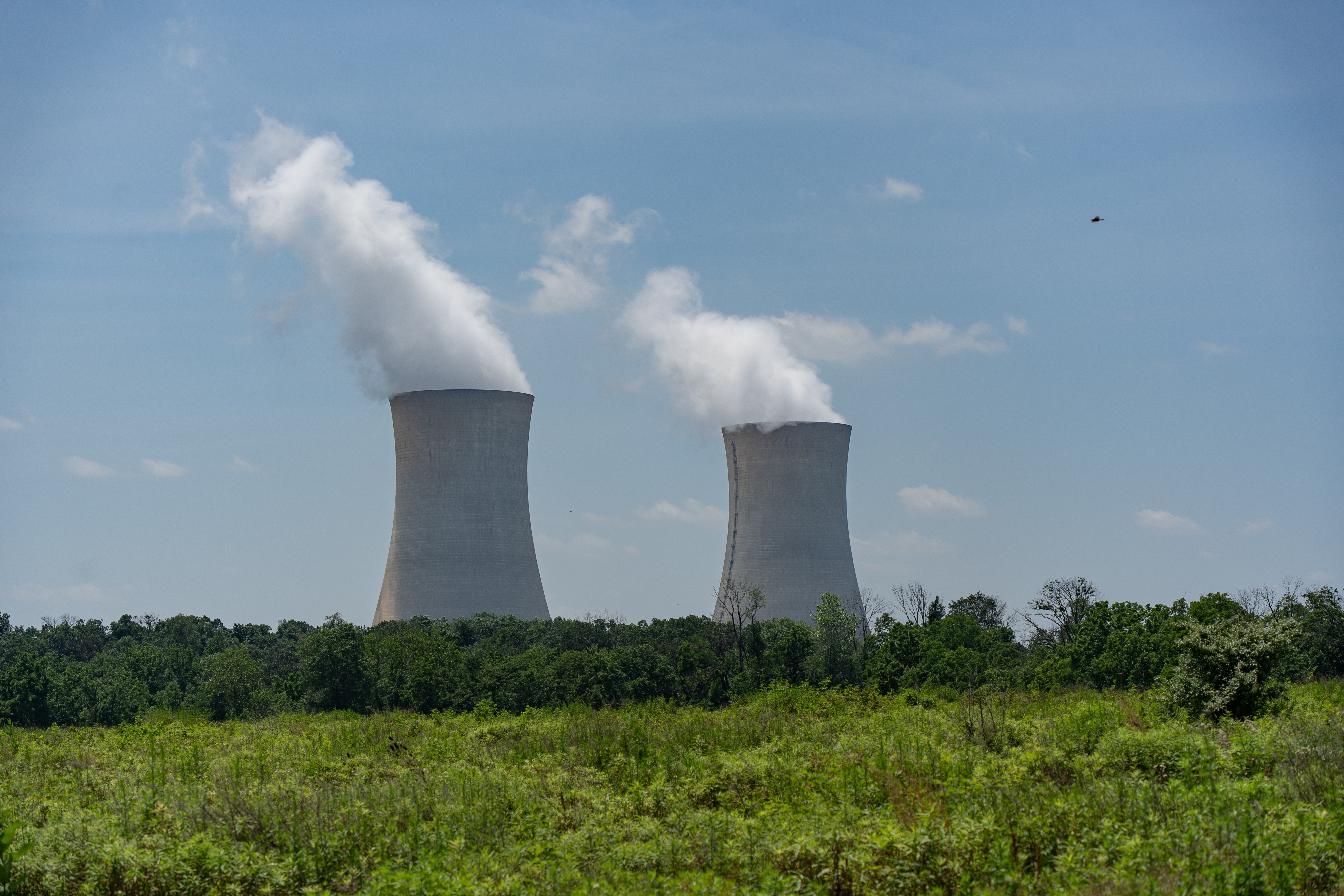


Adding nuclear power is problematic, too. Westinghouse wants to build 10 full-scale reactors, with construction to start in 2030. The company says it has signed letters of intent with seven potential partners, and the Department of Energy is offering $17.5 billion in supply-chain loans. But industry experts say completion would be 15 years away.
Then there is this: Large reactors generate roughly 1 gigawatt of power each, so 10 reactors would add just 10 gigawatts of power to the national grid.
Some small modular reactors may be operating earlier. The largest would produce about one-third of the energy of a big reactor; the smallest design produces about 5 percent.
SMRs are proposed in Ohio and Pennsylvania with the earliest projected to be running in the mid-2030s. Dominion is planning a 300-megawatt SMR in partnership with Amazon but its completion date is uncertain. (It would be built at the North Anna nuclear plant in Louisa County.) Meanwhile, PJM has dropped an Oklo-proposed SMR from its study queue, partly because PJM was not prepared for a multi-fuel project, according to Utility Dive. The plant was to combine fuel cells and gas-fueled generators with a 150-megawatt advanced nuclear reactor. Oklo has appealed to FERC.
The Independent Market Monitor has been arguing for at least a year that the only way to de-stress the PJM grid would be for data centers to buy power from independent generators or build their own power plants – gas, diesel, nuclear – on their sites.
But this idea does not take account of the enormous resistance it would face in Northern Virginia and elsewhere. Loudoun County has allowed one data center to have its own power plant and its neighbors complain vigorously. Fauquier County just nixed a bank of gas-powered generators near Remington, so the developer is hoping that fuel cells, quieter and less polluting though more expensive, will work.
It’s hard to imagine any on-site generation being allowed in Prince William County, where anti-data center activists form a strong coalition.
The astonishing speed with which data centers have sprung up without sensible rules and restrictions has ignited a backlash across the country. Ordinary citizens see the connection between data center expansion and a surge in their bills. And now they associate data centers with artificial intelligence, which they fear will steal their jobs or crush civilization.
As many as 300 local governments have enacted freezes or other permit restrictions on data centers, and pauses or moratoriums are in place in 18 states.
On Sept. 10, the Piedmont Environmental Council called for a statewide moratorium until Virginia figures out how to protect its businesses and residents from data center effects.
This anti-data center movement is powerful and bi-partisan. Prince William Supervisor Tom Gordy recently took his family on a cross-country vacation. He listed 16 states they had traveled through, across America’s northern tier and back through the Southwest.
“And everywhere we went I saw signs that said, ‘No data centers’,” he said.
“Now it's become an issue for congressional races,” he noted. “It's permeating all levels of American politics, and again, it gets back to that one thing: power, which we don't have.”