Part 15

Data centers meet roadblocks around the U.S.

Data centers meet roadblocks around the U.S.

Power limits, moratoriums, opposition delay new projects

Power limits, moratoriums, opposition delay new projects

By Peter Cary, Contributing Writer

The accelerating use of energy-intensive artificial intelligence has contributed to an impending power crisis in Virginia, the biggest data center market in the world. This ongoing series of stories – The New Energy Crisis – explores the repercussions for our region, where our energy will come from, the price to be paid in dollars, safety and quality of life, and potential solutions.

The data center boom doesn’t just threaten the power grid supplying Virginia and the Mid-Atlantic. Fears of shortages are spreading across the country.

With record heat expected this summer, the nation’s grid watchdog just issued its highest alert, telling grid operators to develop better systems to deal with the risks that data centers pose to the nation’s power delivery system.

“The grid faces unprecedented challenges from a surge in large power consumers,” warned the North American Electric Reliability Corp.

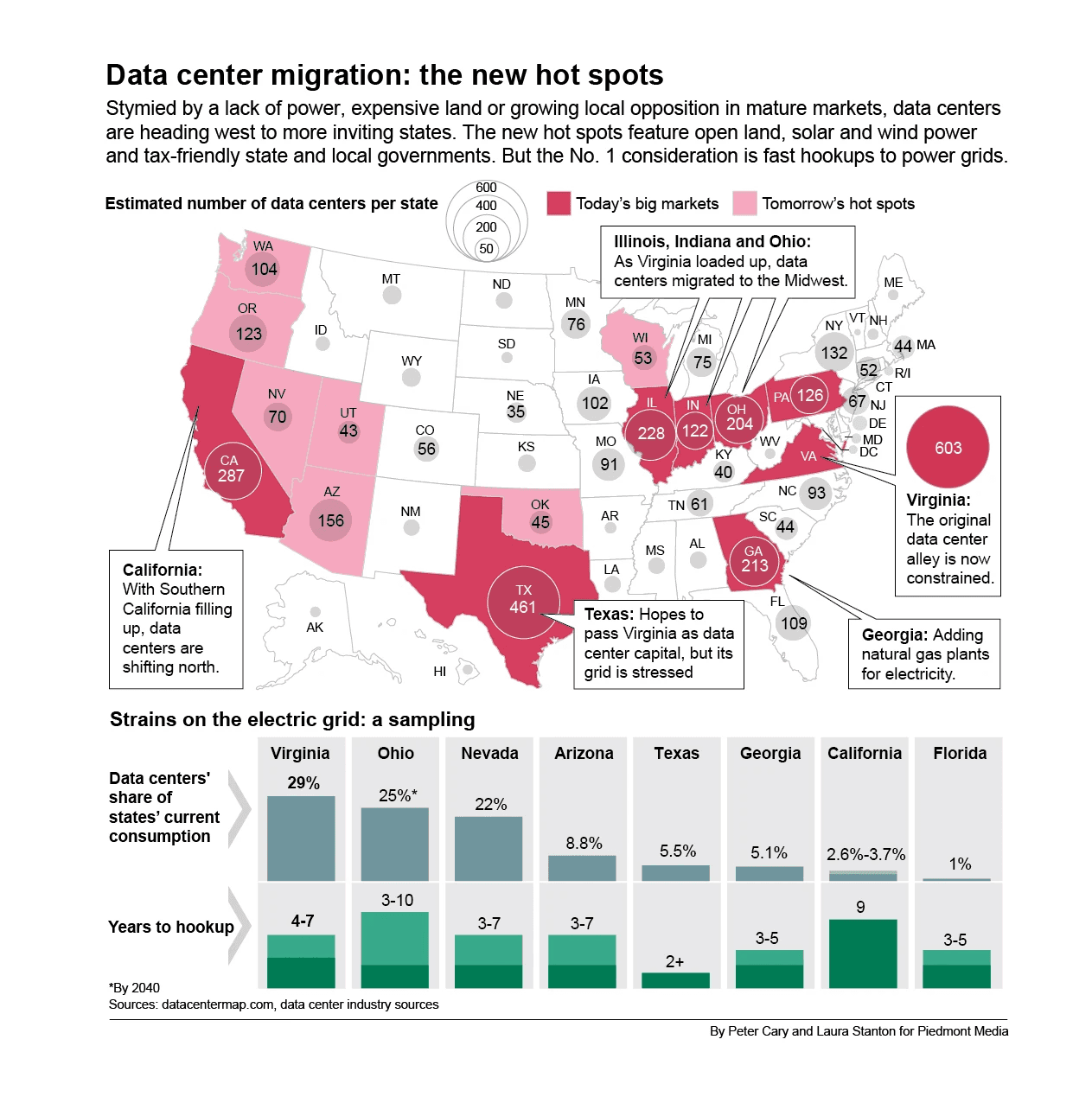
Even power-rich Texas, with a data center concentration second only to Virginia’s, will need to nearly double its electric production in five years. Shortages are possible this summer, and the supply-demand gap could be five times worse by 2029, the state’s grid operator reports.

In Arizona, a state task force has warned that the state’s big data center market is pushing the grid to the brink.

California’s data center power demand is predicted to double from 2023 to 2028. The state’s electricity prices are already twice the national average.

Georgia, one of the country’s fastest-growing data center markets,wants to build five new natural gas plants to keep up with demand.

In Colorado, Michigan, Indiana and West Virginia, inefficient and polluting coal plants that had planned to close are staying open.
Aaron Ruby Headshot
Aaron Ruby Headshot
Submitted photo
Cutting the cost of electricity has been one of President Donald Trump’s key promises to Americans – but costs are still rising.

In the most constrained places, data center companies are having to wait years to plug in. Just like Virginia, data centers in Texas and California have four- to seven-year waits. Georgia and Ohio are not much faster. “Speed to power” is the new mantra, and companies are now looking for places where electricity is more readily available, such as Nevada, Utah, Louisiana, Alabama and Pennsylvania.

“Power is the constraining factor. They are moving to places where there’s capacity, rather than waiting 10 years to get power,” said Prince William County Supervisor Tom Gordy, R-Brentsville.

As utilities struggle to build more energy plants and transmission lines, pressure is mounting on legislators from coast to coast to protect ratepayers from thecosts — both environmental and pocketbook.

Proposals include special power classes for data centers, moratoriums on their construction, and making data centers generate their own power.

Wisconsin imposed the strictest measures in April: Data centers there must pay all their infrastructure costs, including for generators, power lines and substations. They must sign contracts with utilities for 15 years to make sure they fully pay fortheir generation and transmission costs.

Texas, which is power rich and considered data center friendly, not only requires large data centers to pay for their grid connections, but they also must agree to be cut off if extreme weather requires it.  The legislation was passed to avoid another scene like in the winter of 2021 when residents’ homes went dark while large industrial users hummed away.

One result has been data centers building their own gas-powered plants in Texas.  Even so, they still want to connect to the power grid, so the state’s grid operator announced a $33 billion transmission plan to handle the new demand. To protect citizens, the Texas public utilities commission is recommending data centers pay full price for it.
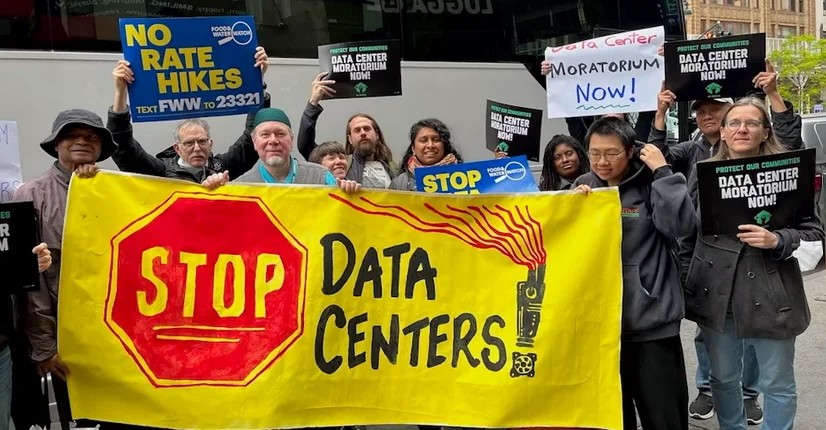
Tougher regulations, moratoriums gain steam

Following Wisconsin’s lead, Florida Gov. Ron DeSantis signed a law last month aimed at ensuring that the extra costs generated by data center demandwill not be borne by other ratepayers.

North Carolina is not far behind. Its legislature wants to set power rates for data centers that cover the cost of all new generation, transmission, and other infrastructure.  And it sets out to eliminate all incentives – tax and otherwise – for data center construction.

The Georgia public utilities commission last year froze all electricity base rates until 2028 to protect consumers from data-center-caused price hikes.

About a dozenstates — including Virginia — have turnedto special rate classes for data centers. Virginia’s takes effect Jan. 1, 2027.

In New York, the state legislature on June 4 approved a one-year moratorium on data center permits while it studies their impact on water and electricity. The legislation requires data centers to invest in their local communities, and it calls for separate water and power rates for the huge projects. The legislation awaits the signature of Gov. Kathy Hochul. 

Virginia law does not allow local moratoriums, but they are faring better elsewhere. Interconnected Capital, a global tech hedge fund that tracks data center activity, reports that 50 moratoriums are active across the U.S. and more are being proposed. A one-year moratorium on data center permits was just passed by the Denver City Council last month, and residents of Monterey Park, California, voted June 2 to permanently ban data centers from the city limits. 

In Maryland, Baltimore County and Carroll County have also enacted one-year moratoriums; the City of Baltimore is considering one; and Montgomery County is looking at a six-month pause in data center permitting so their effects can be examined.

“Tech is outpacing regulation,” said Baltimore resident RaychelGadson, of the South Baltimore Community Land Trust, as she asked the city to study data center effects at a May 7 city hearing. “It’s outpacing our power grids.”

Opposition surges

Another notable data center shift is away from urbanized centers. According to the Pew Research Center, 3,000 data centers are operating in the U.S., with 1,500 more in stages of development. Of those planned, 67% are proposed for rural areas, where they can boost struggling local economies.

Yet in rural areas, data centers are meeting pushback over their effects on electric bills, water and noise. According to Data Center Watch, which tracks local reporting, 48 projects worth $156 billion were stopped or stalled by community opposition in 2025.

Local opposition in Wisconsin, where 50 data centers are operating, has killed at least threedata center projects, in Brown County, Racine County, and DeForest Village. In DeForest Village, a QTS plan for a 1,600-acre, $12 billion project planned on farmland was rejected unanimously by the village board in February.

Last month, city officials in Fayetteville, a suburb of Atlanta, concerned about the power and water use of anearby 1,600-acre QTS complex, banned data centers in all its zones.

Residents of Monterey Park, California, Augusta Township in Michigan, and Janesville, Wisconsin, all will vote this year on measures to restrict or stop data center development, Politico reports.

In Virginia, hostility toward data centers is mounting. A Washington Post poll in late March found that 59%of Virginia residents would not be comfortable with a data center near their home, and 67% want the state to end its sales tax incentives for data centers.

In Fauquier County, community opposition killed a four-building data center project in Catlett and has slowed development of two other projects underway near Remington.

In Prince William County, a resident-led lawsuit has stalled the 37-building Digital Gateway, a 1,700-acre project near the Manassas National Battlefield Park that would have required three to six newgigawatts of power, a dozen new substations and more transmission infrastructure.

Transmission projects are proving to be a bottleneck, but they are also a lightning rod for protest. The Fauquier County Board of Supervisors is on record opposing any transmission lines that cross the county to serve data centers to the north and east.

Recently, in Prince William, nearly 100 people showed up at a Dominion Energy town hall in Bristow to protest construction of transmission lines through their Braemar neighborhood. In Orange County, more than 300 residents attended a meeting in March seeking information about a towering 765-kilovolt line planned to traverse their county to serve data centers to the north.

Following that, in April, theGoochland County board allocated $250,000 to support people opposing those power lines, and on May 1, Goochland, Fluvanna, Culpeper, Orange and Louisa counties jointly filed a protest petition with the Federal Energy Regulatory Commission.

Residents complained that unsightly towers would ruin rural views and decrease property values while serving data centers outside their counties rather than local needs.

Opposition surges

Another notable data center shift is away from urbanized centers. According to the Pew Research Center, 3,000 data centers are operating in the U.S., with 1,500 more in stages of development. Of those planned, 67% are proposed for rural areas, where they can boost struggling local economies.

Yet in rural areas, data centers are meeting pushback over their effects on electric bills, water and noise. According to Data Center Watch, which tracks local reporting, 48 projects worth $156 billion were stopped or stalled by community opposition in 2025.

Local opposition in Wisconsin, where 50 data centers are operating, has killed at least threedata center projects, in Brown County, Racine County, and DeForest Village. In DeForest Village, a QTS plan for a 1,600-acre, $12 billion project planned on farmland was rejected unanimously by the village board in February.

Last month, city officials in Fayetteville, a suburb of Atlanta, concerned about the power and water use of anearby 1,600-acre QTS complex, banned data centers in all its zones.

Residents of Monterey Park, California, Augusta Township in Michigan, and Janesville, Wisconsin, all will vote this year on measures to restrict or stop data center development, Politico reports.

In Virginia, hostility toward data centers is mounting. A Washington Post poll in late March found that 59%of Virginia residents would not be comfortable with a data center near their home, and 67% want the state to end its sales tax incentives for data centers.

In Fauquier County, community opposition killed a four-building data center project in Catlett and has slowed development of two other projects underway near Remington.

In Prince William County, a resident-led lawsuit has stalled the 37-building Digital Gateway, a 1,700-acre project near the Manassas National Battlefield Park that would have required three to six newgigawatts of power, a dozen new substations and more transmission infrastructure.

Transmission projects are proving to be a bottleneck, but they are also a lightning rod for protest. The Fauquier County Board of Supervisors is on record opposing any transmission lines that cross the county to serve data centers to the north and east.

Recently, in Prince William, nearly 100 people showed up at a Dominion Energy town hall in Bristow to protest construction of transmission lines through their Braemar neighborhood. In Orange County, more than 300 residents attended a meeting in March seeking information about a towering 765-kilovolt line planned to traverse their county to serve data centers to the north.

Following that, in April, theGoochland County board allocated $250,000 to support people opposing those power lines, and on May 1, Goochland, Fluvanna, Culpeper, Orange and Louisa counties jointly filed a protest petition with the Federal Energy Regulatory Commission.

Residents complained that unsightly towers would ruin rural views and decrease property values while serving data centers outside their counties rather than local needs.

A Project by the Fauquier Times and Prince William Times