Part 12
By Peter Cary, Contributing Writer
March 24, 2026
Cutting the cost of electricity has been one of President Donald Trump’s key promises to Americans. It was captured succinctly at an October 2024 rally in Detroit when he pledged, “From January 20 – I take office on January 20 – your electric bill, including cars, air conditioning, heaters, everything, the total electric bill will be 50, five-zero, percent less.”
And shortly after he was sworn in as president, Trump issued an executive order declaring the nation’s “inadequate energy supply and infrastructure causes and makes worse the high energy prices that devastate Americans -- particularly those living on low-and fixed incomes.”
Trump said he would fix it.
Last month a White House spokesman doubled down: “Lowering energy costs for American families and businesses will continue to be a top priority in the new year,” Taylor Rodgers told Inside Climate News.
But as Trump campaigns for the 2026 midterms on “affordability,” electricity costs are stubbornly rising, and Trump’s policies seem to be part of the reason.
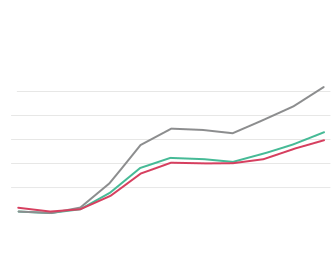
In Virginia, the cost of electricity rose nearly 13% between 2024 and 2025, according to the National Energy Assistance Directors Association. Democrats on the U.S. Congress’s Joint Economic Committee calculated that Virginians paid $130 more for power in 2025 than they did the previous year. And Dominion customers just got a $11.26 rate hike for 2026.

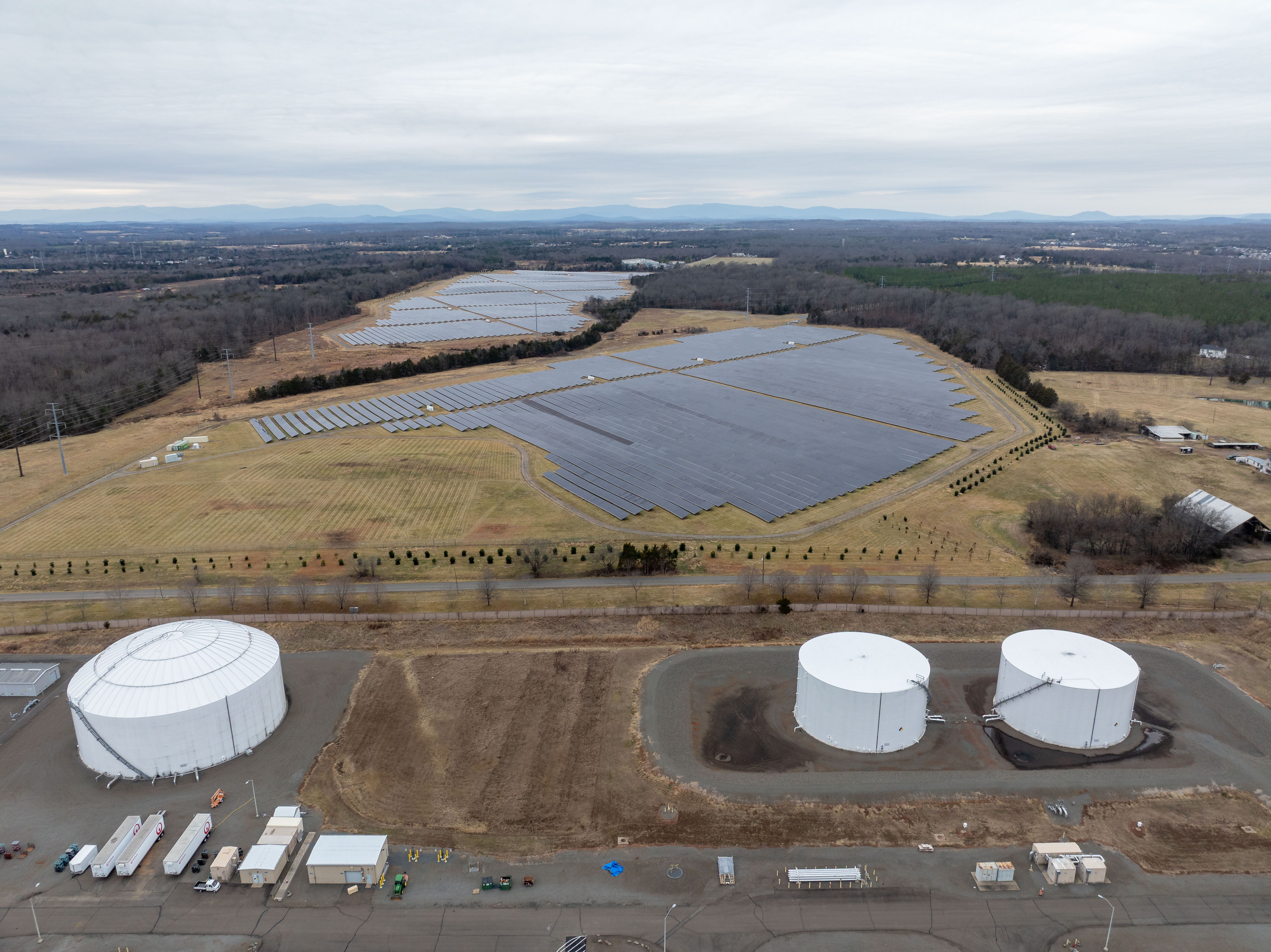
Cutting the cost of electricity has been one of President Donald Trump’s key promises to Americans – but costs are still rising. Submitted photo.
Trump has awakened to the fact that data centers and AI have become major factors in the nation’s energy crisis and zooming power prices. On Wednesday, he obtained pledges from some big tech companies, like Microsoft and Open AI, to cover the costs for power generation they need.
Not all of Trump’s initiatives will hike bills immediately, and some should help the grid become more reliable. But many will push electric bills upward, according to government data and experts consulted by Piedmont Media. They cited:
He is trying to block offshore wind and solar projects.
He is reviving costly coal plants.
He is trying to expedite construction of expensive nuclear energy.
He is moving to export more of the country's natural gas.
“He's trying to create this image of him creating more energy opportunities in America with slogans like, ‘drill, baby, drill,’ and he talks a lot about lowering energy costs, because, you know, ‘clean energy is the villain that is the true source of higher energy costs,’ “ said U.S. Rep. Suhas Subramanyam, a Democrat whose 10th district includes Loudoun, Fauquier, and parts of Prince William counties. “But the reality of his policies is the opposite. He has done more to raise energy costs than any recent president.”
The Department of Energy did not respond to requests for comment.
'Tilting at windmills
The Trump administration’s most puzzling energy initiative came on Dec. 22 when the Interior Department halted the construction of five offshore wind projects in four states, including Virginia. National security was cited, with no further explanation.
Dominion’s Virginia Coastal Offshore Wind project had installed all of its 176 tower bases and was ready to install the towers and windmill blades. It was scheduled to start supplying energy in late 2026.
On Jan. 16 a federal judge ruled that the contractor could go back to work while Dominion fights the administration’s stop-work order. Dominion spokesman Aaron Ruby said the stoppage had cost $5 million a day, a $125 million total expense that could be passed on to ratepayers.
Dominion and its 50% partner Stonespeak have already sunk $9.8 billion into the $11.2 billion project, and ratepayers are paying about $11 a month for it, Ruby said.
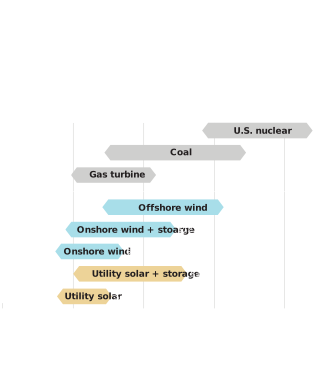
Critics of the project argue that offshore wind is expensive and cannot always be relied on. Data recently released by financial advisory service Lazard Inc. shows that offshore wind is the most expensive form of renewable energy, twice as expensive as onshore wind or solar.
But Trump is also stalling and stopping onshore wind projects. “My goal is to not allow any windmill be built,” he told fuel executives in January.
Virginia has no onshore wind yet, but one 13-tower project by Apex Clean Energy is underway north of Roanoke and is planning to deliver energy by year’s end. Company spokesman Brian O’Shea said the wind farm was permitted and financed by last September and is not affected by Trump’s bill.
The 2.6 gigawatts of power from the offshore wind farm was part of Dominion’s reliability planning for 2027. If the wind farm is halted, Dominion will have to turn to other sources of power – most likely natural gas, whose generators would take at least five years to build. Meanwhile, the shortage of power would push up the cost of electricity.
“Obviously, if you've got less supply, then supply and demand factors tell you that stopping those offshore wind projects is going to drive up prices,” said Adam Winer, communications director at Advanced Energy United, which advocates for clean-energy producers.
Atomic ambitions
Unlike his position on solar and wind, Trump is all in on nuclear energy. He has set a goal of quadrupling America’s nuclear power generation, from 100 gigawatts now to 400 gigawatts by 2050–even though nuclear energy is more expensive than wind, solar, gas or coal.
On Jan. 20, Trump unleashed initiatives to bolster what the Energy Department called “America’s next nuclear renaissance”: $2.7 billion to strengthen domestic uranium enrichment, $800 million to the Tennessee Valley Authority to build small nuclear reactors, a $1 billion loan to renew a shuttered Three Mile Island reactor, steps to boost advanced nuclear reactors, and reforming the Nuclear Regulatory Commission to reduce nuclear industry hurdles.
That follows tax credits in the One Big Beautiful Bill Act for new nuclear power production, for upgrades at existing nuclear plants, and $125 million for development of small modular reactors on military bases, a program that is under way.
The administration is also guaranteeing $1.52 billion in loans to restart the Palisades Nuclear Power Plant in Michigan, a program launched by the Biden administration.
The restarts and upgrades are expected to take less time than the building of a nuclear plant from scratch.
The two most recent ones, which began operating in Georgia in 2023 and 2024, took 15 years to complete and cost twice the estimates. While nuclear advocates say the cost -- $36 billion -- may be an aberration, there is no question that nuclear power is more expensive than solar, wind, or gas.
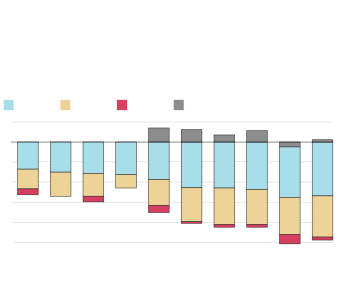
According to data from the Energy Information Agency, at $141 to $229 per megawatt-hour, nuclear power is more than three times as expensive as solar and wind and twice as expensive as natural gas.
Ratepayers in Georgia suffered a double whammy with Vogtle 3 and 4 reactors. They have to absorb a substantial part of the cost overruns and have to pay the higher cost of nuclear electricity. Estimates vary, but some calculate the average Georgia power bill to be $261 a month for a 1,000 kw user. (Dominion says its 1,000 kw users will pay about $160 monthly this year.)
“Vogtle is a cautionary tale for the rest of the country. Here in Georgia, we’re stuck with the most expensive power ever produced, nothing to take pride in,” said Brionté McCorkle, executive director of Georgia Conservation Voters.
The costs of coal
One reason for the looming shortage of power is the planned retirement of aging and dirty coal plants, so the Trump administration has ordered many to stay open. His energy department will tap a $625 million fund to keep them running, and on Feb. 11 Trump ordered the Pentagon to give preference to coal-based electricity in its long-term energy contracts.
He says his actions will add 17 gigawatts of power to the stressed grid.
Advocates for green energy argue that the majority of old coal plants were closing for economic reasons, and that regional transmission groups can keep specific coal plants on in true emergencies.
“This administration has created a bias against clean energy sources, even when the economic case is clear to use them, and they have created a hierarchy where they want to tip the scales towards fossil fuel energy sources and against wind and solar,” said Rep. Subramanyam.
In an August report for four environmental groups, Grid Strategies, a D.C.-based consulting group, said keeping open 54 of the nation’s coal plants that want to close will cost consumers $3.12 billion a year.
Even America’s Power, a national coal fleet trade organization, acknowledges that keeping old coal plants open will cost, perhaps $195 million per year. For context, they say, Americans spend nearly $500 billion a year on electrical power.
Not all plants slated to close want to be kept open.
The co-operators of a coal plant in Craig, Colorado, say their ratepayers will have to bear the $80 million-a-year burden of keeping the plant open, as ordered by the Energy Department. Tri-State Generation and the Platte River Power Authority have asked the department to reconsider its decision.
Replacing coal plants with gas-powered generators is not cheap either. When Dominion Energy secured permission to replace its Chesterfield coal plant with a 944-megawatt gas peaking plant, the State Corporation Commission allowed Dominion to recover $1.42 billion of the $4.5 billion project from ratepayers.
Dominion has three coal plants remaining and does not plan to close any of them due to the high demand on its grid from data centers. According to a Dominion planning document, less than 6% of energy delivered to customers comes from those coal plants. (About 40% comes from natural gas turbines, and 26.5% comes from nuclear reactors.)
Natural gas
The Center for American Progress, a left-leaning think tank, reported in October that 49 of 50 states are seeing higher natural gas bills due to the Trump administration’s increased export of liquified natural gas, which tightens the U.S. domestic supply.
According to the U.S. Energy Information Administration, natural gas prices are likely to increase by more than 75% between 2024 and 2026.
Natural gas is what fuels most of the power on Dominion Energy bills; the category of “fuel charge" is about one-fourth of a typical residential bill.
Dominion’s solar field in Remington supplies 20 megawatts of energy. But the One Big Beautiful Bill significantly cut subsidies and tax breaks for new solar facilities, and he tried to stop construction of Dominion’s 2,600 MW offshore wind farm. Photo by Doug Stroud.
Transmission
Trump, in an executive order on Day One of his second term, declared a national emergency due to the nation’s inadequate power generation and transmission. He ordered the heads of all agencies, including the U.S. Army Corps of Engineers and the EPA, to ease up on regulations that slow the building of electrical infrastructure.
“Inadequate transmission capacity raises power prices for consumers,” wrote Grid Strategies in a November report. It said power line congestion was making it harder for cheap energy to reach customers.
It’s hard to argue with the benefits of a modernized grid. But Trump's orders would ease the way for the building of hundreds of miles of new transmission lines for data centers. And for that there is serious pushback from local ratepayers, who pay half the cost.
“If you're trying to lower energy costs, why wouldn't you do more to prevent cost shifting from large users of energy to residential and small business owners who have to foot the bill like they do in Virginia?” asks Subramanyam.
Trump says he is heading in that direction with the pledges he obtained on March 4. In his State of the Union address on Feb. 24, he said the pledges would keep energy bills stable or “in many cases” drive them down.
But it’s unclear how that would happen. Unless data centers are disconnected from the grid and agree to help pay the bills of others, those bills will continue to rise. Too many forces, including those of Trump’s own making, are pushing the cost of power up.
Peter Cary can be reached at pcary@fauquier.com.